TL;DR
- Helicopter raids in California from 1983 made big outdoor gardens easy to find, so growers went small, hidden and indoors.
- Indica from Afghanistan stayed short, handled the cold and finished early, which made small gardens possible.
- Indoor rooms under sodium lamps only paid if every plant counted, so growers bred for potency.
- Operation Green Merchant in 1989 raided garden stores in 46 states, and the grows got smaller again.
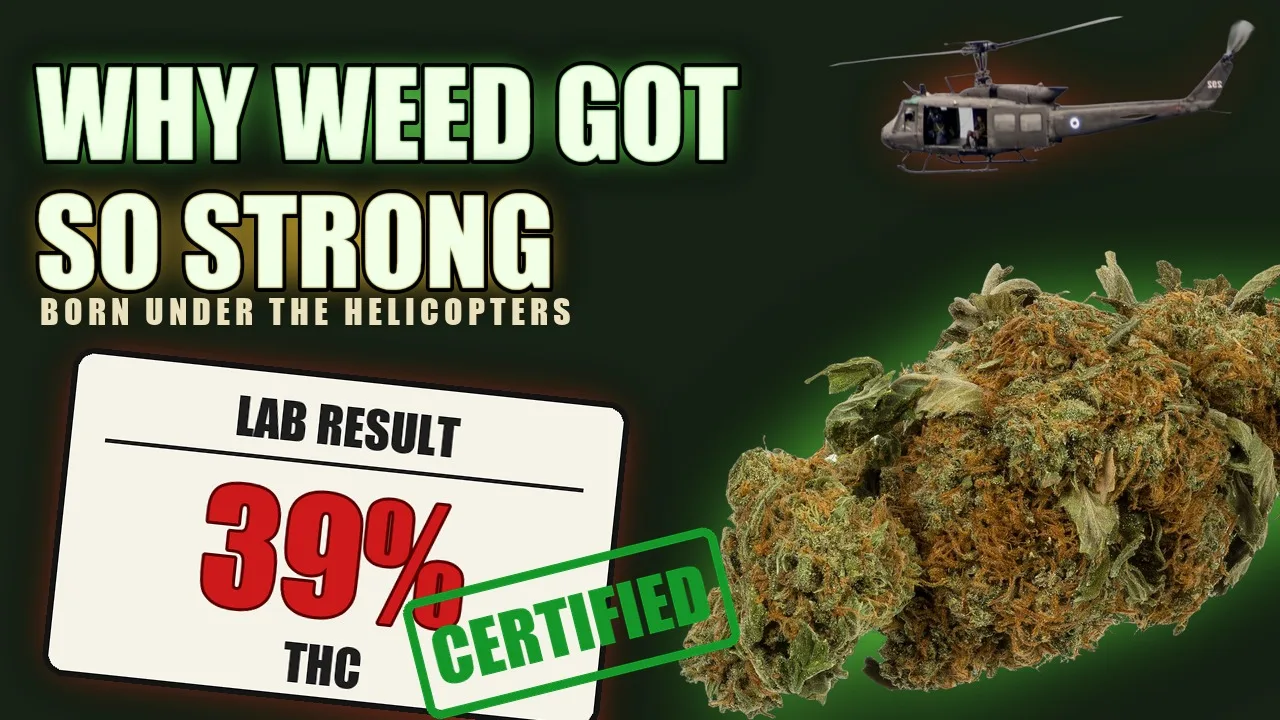
- Federal testing shows seized weed going from about 4% THC in 1995 to about 12% in 2014, and 17.1% in 2017 by a later count. Labels on legal weed often claim more than the bud tests at.
On October 26, 1989, DEA agents walked into Full Moon, a garden store in Corvallis, Oregon, and hauled out about $30,000 worth of equipment. That same week, agents hit indoor growers and garden stores in 46 states. Growers called it Black Thursday.
The DEA went after garden stores because by 1989 the government had already chased growers off the hills and into their closets. What they grew in there was strong enough that the DEA's own history book later called American weed "the most sought-after cannabis in the world."
That's most of why weed is so strong now. Each push from law enforcement made growers go smaller and better hidden, and a smaller crop had to be worth more. The full story is in the video above. Here it is in writing, with sources.
How did helicopters change what growers planted?
In the late 1970s, back-to-the-land growers in Northern California made their name with sinsemilla, seedless bud from female plants kept away from pollen. By 1984, the Christian Science Monitor reported it was going for about $2,000 a pound, and the government had noticed.
In 1983, California started CAMP, the Campaign Against Marijuana Planting. It covered 14 counties its first year and 37 the next. Its first report says Huey helicopters flew the raid crews in, and that helicopters "proved to be the most safe, efficient, and successful means of operating."
From the air, a big garden is easy to see, and a greenhouse is easier. CAMP's 1984 report says large gardens were "now the exception rather than the rule," and that greenhouses were fading out because aerial surveillance spotted them so easily. Its sources said there might be more indoor growing, and "much more in the future as a result of CAMP outdoor field operations." That summer, Tom Byrne, head of the DEA's cannabis section, told the Monitor that growers were "going to indoor cultivation and smaller plots."
The growers who stayed outside spread into smaller plots and camouflaged them. In many cases, CAMP's 1985 report says, the grower didn't plant "a garden for a year or two hoping that CAMP will go away."
What did indica have to do with it?
In the seventies, the weed Americans prized came from Mexico and Colombia, and the only plant American growers knew, according to Michael Pollan's 1995 New York Times Magazine story "How Pot Has Grown," was sativa. Some sativas grew 15 feet tall, which is a lot of plant to hide from a helicopter.
Farmers in Afghanistan grew something else. Pollan described Cannabis indica as a "stout, frost-tolerant" plant "cultivated for centuries in Afghanistan by hashish producers," one that "rarely grows taller than four or five feet." Young Westerners on the Hippie Trail brought seeds home, and Pollan dates indica's arrival to the second half of the 1970s, years before CAMP.
Indica, Pollan says, "allowed growers in all 50 states to cultivate sinsemilla for the first time." It stayed short and handled cold nights, and growers liked it for an early harvest and a heavy yield. Around 1980, amateur breeders on the West Coast were crossing it with sativa in what Pollan calls "a flurry of breeding work," and most modern American weed comes out of those crosses.
CAMP measured what happened next. Its 1989 report says the average plant agents pulled weighed 6.3 pounds in 1984, 2.4 pounds in 1988 and 1.4 pounds in 1989. Part of the reason, the report says, was "breeding down in size to help prevent detection."
Mark Kleiman, a drug policy analyst who had worked in the Reagan Justice Department, explained it to Pollan: "Law enforcement makes large-scale production difficult. So growers had to figure out a way to make a living with a smaller but better-quality crop."
When did people start growing weed indoors?
Indoors, growers had to supply the light. By the 1980s they were using metal halide lamps and high pressure sodium lamps with their orange light. In 1995 the Monitor described indoor growers "armed with high-pressure sodium lights," turning out "as many as four crops of highly potent marijuana a year in basements, attics, and walk-in closets."
Grow shops advertised in High Times like any other business, and a November 1985 ad for a $399 grow cabinet ran under the headline "Some things belong in the closet." Around 1987, Pollan writes, the method came together as the Sea of Green: dozens of plants packed tight, all female and all clones of the grower's best plant.
The police kept count. CAMP took down 172 indoor grows in California in 1987 and 270 in 1988. The DEA's 1989 report says, "During 1987, indoor cannabis cultivation emerged as a significant and increasing problem." By the DEA's estimates, as Pollan reports them, the home grown share of the American market doubled from 12% in 1984 to 25% in 1989.
Allen St. Pierre of NORML told Pollan, "The Government pushed growers indoors. Before programs like CAMP, you almost never heard about indoor grass." In a small, hot room, every plant had to earn its spot, and Pollan wrote that the move indoors set off a rush of breeding for potency, size and early harvest.
Where did Skunk #1, Northern Lights and Trainwreck come from?
All three come with a lot of lore, so here is what can be shown and what can't.
The story goes that a California breeder known as Sam the Skunkman bred Skunk #1 from Afghani, Colombian Gold and Acapulco Gold. The hard evidence is a seed catalog for Bay Area growers dated February 1981 and reprinted in High Times. It lists Skunk #1 at $2 a seed and says the strains "can be grown outside," so Skunk #1 was on sale before the indoor boom. Sam later moved to the Netherlands and took his seeds. Asked by High Times writer Todd McCormick how he made it breed true, he said, "I didn't, nature did." He died in January 2025.
For Northern Lights, McCormick writes that a grower known as Seattle Greg got four seeds labelled pure indica and bred them through the early 1980s, and that in 1985 the Seed Bank got eleven numbered versions. Nobody has proven any of it.
Trainwreck is the Humboldt one. The usual story is that two brothers in Arcata bred it from Mexican, Thai and Afghani lines and named it after a nearby train wreck that made them harvest early. Every telling we found comes from seed sellers and dispensary blogs, and we couldn't find a single document behind it.
You can look up all of these, along with Afghani and Hindu Kush, in Strain Guide.
What was Operation Green Merchant?
In 1987, a DEA agent named Jim Seward was flipping through High Times. The magazine, he later told a reporter, "just seemed to be a middleman in a dope deal." The grow shops advertised in it and their customers read it, so in 1988 the DEA built Operation Green Merchant around it, aimed at "the indoor growing industry including suppliers of seeds, equipment and cannabis cultivators."
Agents posed as customers and asked leading questions. At Full Moon, Reason magazine reported, one agent told a salesman, "I want to grow some Sinsemilla bud." The salesman answered, "I can't sell you any equipment if you're going to tell me that." Reason, citing U.S. News and World Report, also said the DEA subpoenaed UPS shipping records for 29 gardening equipment companies and came away with about 21,000 customer names. UPS denied handing over any records.
Almost every store hit in October 1989 had advertised in High Times or in a grower's magazine called Sinsemilla Tips. Reason counted 259 arrests between October 26 and November 2, and the DEA's report for 1989 counts 441 arrests that year, 356 indoor grows taken down, more than $9 million in assets seized and over 30,000 leads.
Not everyone on those lists grew pot. One was a man in Raleigh who grew orchids and had bought a light meter by mail. He let state agents search his house, and they found nothing. "I had the impression that if I made them get a warrant, they would tear the house apart," he told Reason. Sinsemilla Tips lost so many advertisers that it went out of business.
A federal law passed in 1988 had also set mandatory sentences by plant count, five years for 100 plants and ten for 1,000, so growers kept rooms under 100 plants and watched their power bills.
How much stronger is weed today than in the 1970s?
For decades, the University of Mississippi has tested seized cannabis for the federal government, and it also grows cannabis for research under a federal contract. In 2023 it announced a new five-year contract with the National Institute on Drug Abuse "for the cultivation of marijuana and related materials for research," with a 12-acre field.
The DEA's history book says THC averaged 1.5% in 1970, but critics said even then that the early figures ran low, and a 1988 paper put mid seventies weed at an average of 2% to 5%. A 2016 paper from the Mississippi program found average THC in seized cannabis went from about 4% in 1995 to about 12% in 2014. A later paper from the same lab, counting a little differently, put 2017 at 17.1%. That's about four times stronger in a little over twenty years.
The researchers said the rise in sinsemilla samples "has been the cause of the overall increase in potency," and that "the drug using community and the cannabis producers are breeding plants for the higher THC content." They add a caveat: many seized plants are pulled while still growing, so the numbers may not match what ends up being sold.
Mel Frank, a grower and author who watched the whole climb, had stopped caring about the number by 2015. "I care about the fragrance and flavor, ok? ... Once you get into the teens what difference does it make?"
Is the THC percentage on the label accurate?
On a legal shelf, the THC number sells the weed. A 2023 study in PLOS ONE says consumers "are willing to pay more for higher potency flower." Its authors tested 23 flower samples from ten Colorado dispensaries, a small study. Labels ran from 12.8% to 33%. The 33% was the top of a 17.33% to 33% range printed on a Blue Dream label, and that sample tested at 14.91%, below even the bottom of its range.
The average came in at 14.98%. About 70% tested more than 15% below their label, though two samples beat the top figure on theirs. The researchers say the cause is hard to pin down and name lab shopping as one suspect: growers and dispensaries seeking out the labs that give them the results they want.
A 2021 study of about 200,000 test results from Washington and Nevada found a jump right at 20% THC. In Nevada, about 43% more samples landed just over 20% than just under it. In Washington the biggest jumps were at two labs that had their licenses suspended for testing problems, while the state's biggest lab showed almost none.
In June 2024, two California labs sued a long list of rival labs in federal court. Their complaint says brands look for labs that will "give them the most inflated THC levels, regardless of what is supported by empirical data." Those are allegations in a lawsuit, not findings.
So when a jar says 33%, maybe it is, or maybe somebody went shopping for that number.
If you grow, Grow Guide is our free app for keeping a grow journal. Coming episodes cover Brownie Mary, the volunteer who baked pot brownies for AIDS patients in San Francisco, the Humboldt neighbors who took the CAMP helicopters to court, and the heat camera case that went to the Supreme Court.
Why is weed so strong FAQ
Why is weed stronger today than in the 1970s?
Growers bred for THC. Helicopter raids and later crackdowns pushed them into small, hidden gardens, where a smaller crop had to be worth more. The government's own lab says the rise of sinsemilla caused the increase.
How strong was weed in the 1970s?
The DEA's history book puts the 1970 average at 1.5% THC. Critics said those figures ran low, and a 1988 paper put mid seventies weed at 2% to 5%.
How strong is weed today?
A paper from the University of Mississippi's federal testing program put seized cannabis at 17.1% THC on average in 2017, up from about 4% in 1995. Legal labels often claim more.
Where did indica come from?
Afghanistan, where hashish makers had grown it for centuries. Travellers on the Hippie Trail brought seeds home, and it reached American growers in the second half of the 1970s.
Are THC percentages on cannabis labels accurate?
Not always. In a 2023 Colorado study, about 70% of 23 flower samples tested more than 15% below their label.
Sources
- Reason, Jacob Sullum, "Reefer Madness," February 1990: https://reason.com/1990/02/01/reefer-madness1/
- Michael Pollan, "How Pot Has Grown," New York Times Magazine, February 19, 1995: https://michaelpollan.com/articles-archive/how-pot-has-grown/
- DEA history book, part 1, via the UNT web archive: https://webarchive.library.unt.edu/web/20090813215436/http://justice.gov/dea/pubs/history/history_part1.pdf
- DEA history book, part 2, 1985 to 1990
- Clara Germani, Christian Science Monitor, August 30, 1984: https://www.csmonitor.com/1984/0830/083019.html
- CAMP 1983 final report, Humboldt State University special collections: https://humboldt.edu/special-collections/sites/default/files/camp1983.pdf
- CAMP 1984 and 1985 annual reports, Humboldt State University special collections
- CAMP 1989 report, Humboldt State University special collections: https://humboldt.edu/special-collections/sites/default/files/camp1989.pdf
- Todd McCormick, "The Primary Colors of Cannabis," High Times, June 6, 2023: https://hightimes.com/culture/the-primary-colors-of-cannabis/
- Chris Simunek, interview with Mel Frank, Paradise Burning, 2018: https://www.paradiseburning.com/single-post/2018/04/27/when-we-were-criminals-an-interview-with-mel-frank
- Sam Walker, Christian Science Monitor, August 25, 1995: https://www.csmonitor.com/1995/0825/25013.html
- High Times, February 1982 (seed catalog effective February 1981) and November 1985 (grow cabinet ad), via the Internet Archive
- DEA, 1989 Domestic Cannabis Eradication/Suppression Program report: https://www.ojp.gov/pdffiles1/Digitization/126492NCJRS.pdf
- University of Mississippi, new NIDA contract, June 2023: https://olemiss.edu/news/2023/06/university-awarded-new-nida-contract
- Mikuriya and Aldrich, "Cannabis 1988: Old Drug, New Dangers. The Potency Question," Journal of Psychoactive Drugs, 1988: https://pubmed.ncbi.nlm.nih.gov/3292744/
- ElSohly et al., 2016, potency 1995 to 2014, Biological Psychiatry: https://pubmed.ncbi.nlm.nih.gov/26903403/
- Chandra et al., 2019, potency in 2017: https://pubmed.ncbi.nlm.nih.gov/30671616/
- Schwabe et al., "Uncomfortably high," PLOS ONE, 2023: https://pmc.ncbi.nlm.nih.gov/articles/PMC10096267/
- Zoorob, THC results around the 20% threshold in Nevada and Washington, Journal of Cannabis Research, 2021: https://pubmed.ncbi.nlm.nih.gov/33715627/
- Infinite Chemical Analysis Labs v. Pride Analytics et al., C.D. Cal. No. 2:24-cv-05311, complaint filed June 24, 2024 (allegations only): https://ca-times.brightspotcdn.com/2d/50/07ba018143b6acb19ce5220008bb/1-complaint.pdf